
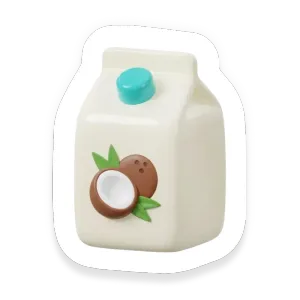
Coconut Milk
Vegan
Last updated July 5, 2026. The Tummi Food Team maintains this Can I Feed This safety guide guide. Supporting links appear in Sources when available.



Clinically reviewed by Andria Procopio and Arefa Mohamed
Direct answer
Can babies eat Coconut Milk?
Yes, coconut milk can be used as an ingredient in complementary foods from around 6 months, once your baby is developmentally ready; do not use it as a drink before 12 months or as a replacement for breast milk or infant formula.
- Serve Age6+months
Most babies start solids around 6 months once they show readiness signs. Match the texture and serving size to your baby's skills.
- No Allergens
Coconut Milk is not flagged as one of the major allergens tracked in this database. Still watch your baby closely when serving any new food.
- Choking Risk123451
Lower choking risk when served in the right texture. Always supervise meals and adjust the shape for your baby.
This guide is for everyday food prep questions. Ask your pediatrician about medical concerns, feeding delays, allergy plans, or serious reactions.
How Do You Serve Coconut Milk?
How to serve Coconut Milk to babies 6 months and older
- 1Shake or stir the can well until solids and liquids are recombined to a smooth consistency.
- 2Warm and whisk coconut milk into sauces, curries, or soups to create a creamy base and improve texture.
- 3Pour over cooked oats, rice, or warm cereals instead of water or regular milk for extra fat and flavor.
- 4Stir a small amount (start with 1 tablespoon) into mashed fruits or vegetables to add moisture and healthy fat; increase to taste.
- 5If the can is very separated or chilled, scoop solids into a jar and blend or gently heat before mixing for a smooth result.
How to serve Coconut Milk to babies 12 months and older
- 1Shake or stir the can or carton until smooth to recombine the cream and liquid before pouring.
- 2Warm gently and add to sauces, warm cereals, or mashed vegetables for creaminess; avoid boiling to keep the texture stable.
- 3Offer a few sips in a small cup so the child can practice sipping and drinking skills, but keep breast milk or formula as the main drink.
How to serve Coconut Milk to babies 18 months and older
- 1Shake or stir coconut milk thoroughly before using to recombine separated liquids for a smooth, even texture.
- 2Use full-fat canned coconut milk for richer dishes (curries, baking) and lighter carton varieties for smoothies or soups to control creaminess.
- 3When adding to drinks or smoothies, start with 1–2 tablespoons and increase as needed to check tolerance.
- 4Store opened coconut milk in a sealed container in the refrigerator and use within 3–4 days; freeze portions in ice‑cube trays for single-use servings.
- 5If anyone in your family has nut or tree-fruit allergies, introduce coconut milk separately and watch for reactions. Contact a healthcare provider if you notice concerning symptoms.
Is Coconut Milk a Common Allergen?
Although coconut is botanically a fruit, the FDA classifies it as a tree nut for labeling. True coconut allergy is uncommon and many people with tree-nut allergies tolerate coconut, but reactions can occur. Coconut milk is dairy-free and typically free of eggs, peanuts, soy, fish/shellfish, sesame and gluten unless other ingredients or cross-contact are present. Check product labels for added allergens or shared-facility warnings and consult your child's allergist before offering coconut milk to a child with a tree-nut or other severe allergy.
Is Coconut Milk a Choking Hazard?
Very Low Choking Risk
Coconut milk presents a low choking risk when handled appropriately for your child’s developmental stage, but any food can potentially cause choking. Stay within arm’s reach during feeds and maintain a calm, attentive eating environment. Know the signs of choking and be prepared to respond if needed.
Have More Questions?
No, coconut milk should not be used as a primary drink for babies under 12 months. It can be included in solid foods from around 6 months but should complement breast milk or formula.
No, coconut milk should not be served as a drink at 6 months. Once your baby is developmentally ready for complementary foods, it can be used as an ingredient in food, while breast milk or infant formula remains the main milk feed during the first year.
Yes, a baby can have an allergic reaction to coconut. Check the ingredient list each time because coconut is no longer required to appear as a major allergen in an FDA “Contains” statement.
Coconut milk is a liquid rather than a solid choking hazard, but no food or drink is risk-free for a baby. Keep your baby seated upright and watch closely while coconut milk is served as part of developmentally appropriate food.
There is no single amount of coconut milk that every baby needs at a meal. Use it as an ingredient in complementary food and let your baby decide how much to eat by responding to hunger and fullness cues.
Save Coconut Milk to your food log
Track foods, reactions, and prep notes in Tummi when you want to keep your baby's feeding history in one place.
Sources
- Food Allergen Labeling Guidance for Industry - FDA (Basics for Industry: Section 201(qq)) fda.gov
- Coconut Allergy Revisited (Anagnostou, 2017) mdpi.com
- Coconut anaphylaxis: Case report and review (Michavila et al., 2015) pubmed.ncbi.nlm.nih.gov
- Prevalence of food allergy in 137 latex-allergic patients (Kim & Hussain, 1999) pubmed.ncbi.nlm.nih.gov
What Other Vegan Can Babies Eat?
See all →
Source-Linked Guidance
See the evidence behind the guide.
Food guides show direct links to public-health guidance and research when supporting references are available. Source inclusion does not imply endorsement.
 Centers for Disease Control and Prevention
Developmental milestones, nutrition guidelines, and allergen introduction timelines.
 American Academy of Pediatrics
Evidence-based feeding recommendations from the leading pediatric authority.
 National Institutes of Health
Peer-reviewed research on infant nutrition, allergies, and food safety.