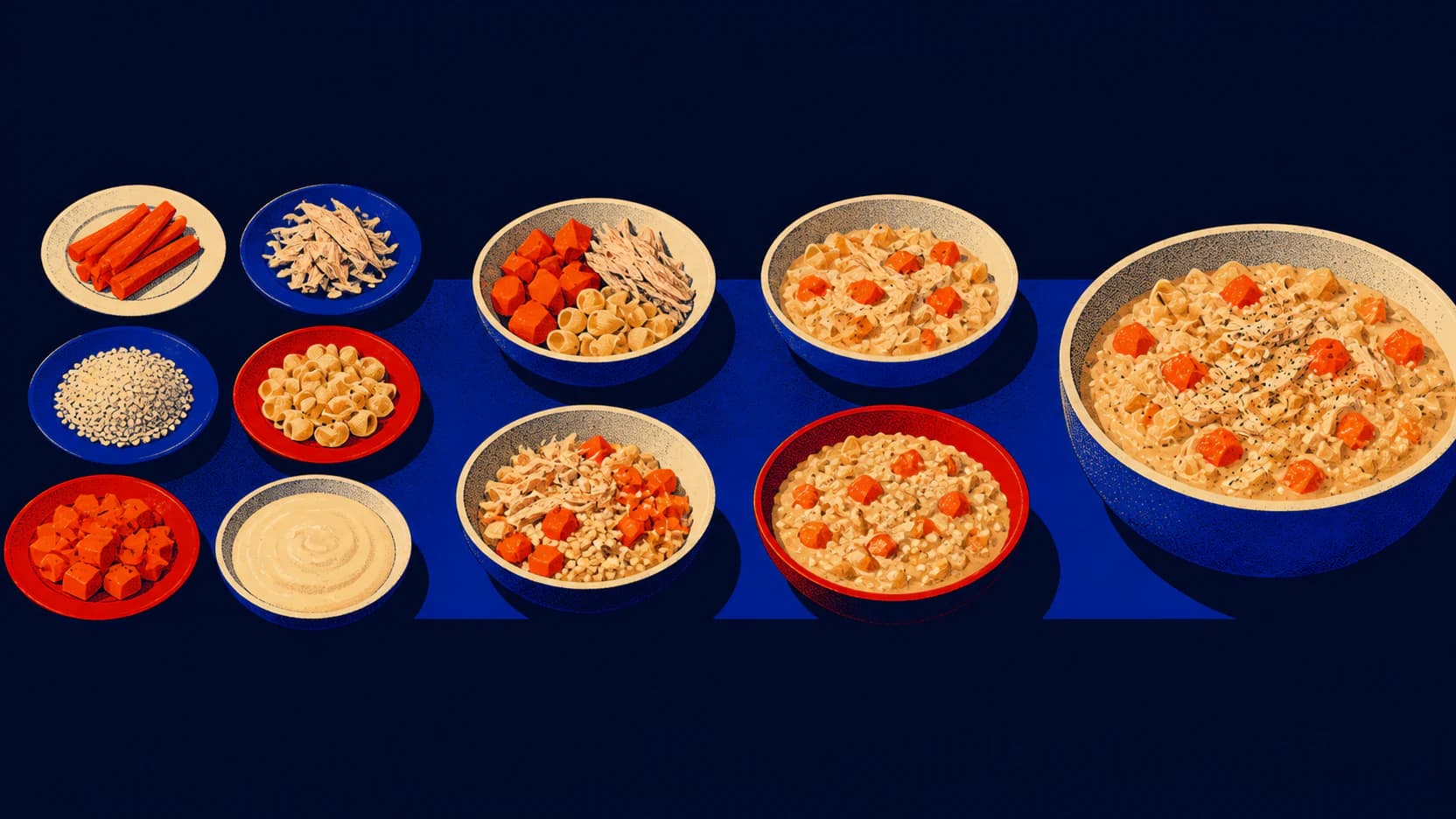
Starting solids often begins with food you can name in one word: banana, carrot, yogurt, oatmeal. Then a spoonful of soup, a soft patty, or part of the family dinner enters the picture, and the meal becomes harder to fit under a single ingredient label.
We isolated Tummi records classified as prepared or mixed and followed their share across the best-sampled ages. The category represented less than 1 percent of recorded solid-food occurrences at month 6, then increased in every published age cell through month 9.
The direction is consistent, but the category stays small. That makes this a narrow finding about how meals were classified in the app, not proof that few babies ate family foods or that most meals truly contained only one ingredient. The label can point toward greater complexity, but it cannot fully describe it.
Key Findings
- Prepared or mixed foods accounted for 0.7 percent of recorded solid-food occurrences at month 6.
- The share rose in every published age cell, reaching 1.1 percent at month 7 and 1.6 percent at month 8.
- By month 9, prepared or mixed foods represented 2.2 percent of recorded occurrences.
- The category remained a small part of the recorded mix even as it grew.
- Prepared or mixed is only a partial proxy for family food, meal sharing, or recipe complexity.
Do prepared and mixed records rise with age?
Yes, within the published window. Prepared or mixed foods accounted for 0.7 percent of recorded occurrences at month 6, 1.1 percent at month 7, 1.6 percent at month 8, and 2.2 percent at month 9. Each step moves in the same direction, which makes the trend easy to see even without a dramatic jump.
The pattern is still modest in absolute terms. From the first published age to the last, the category gained 1.5 percentage points and remained a small slice of the recorded solid-food mix. The evidence supports saying these records became more common with age. It does not support saying they became dominant.
Source: Aggregated Tummi product data. Later age bars are exploratory because the eligible groups are much smaller.
How large is the mixed-food category?
At no point from month 6 through month 9 did prepared or mixed foods reach even 3 percent of recorded occurrences. Most foods in the dataset continued to be assigned to produce, protein and dairy, grains, or other. The chart is most useful when the narrow vertical scale does not make a small absolute change look larger than it is.
Small does not mean meaningless. The steady rise shows an age-associated difference in how meals are classified. It simply needs the right wording: a gradual change in one app category, not a wholesale transition from single foods to family meals.
What does prepared or mixed mean in this analysis?
Prepared or mixed is one primary classification in the published diet dataset. The local report does not provide a full taxonomy or a recipe-level breakdown, so this article does not assign more specificity to the label than the source contains.
The trend measures the share of occurrences assigned to that category. It does not reconstruct ingredients or nutritional composition, and it cannot tell us how a particular meal would have been divided under a different classification system.
Does a mixed record prove that a baby ate family food?
No. A prepared or mixed label does not tell us who cooked the meal, whether the rest of the family ate it, or whether the baby's serving was adapted from a shared dish. It also does not show whether the baby swallowed the food. Calling the category family food without that context would make the data sound more precise than it is.
The category can still serve as a partial signal that some recorded meals are becoming harder to describe as one ingredient. That interpretation fits the gradual rise, but it should stay framed as an inference from classification. The underlying records do not include the social setting of the meal or a direct family-meal flag.
How should parents interpret the change?
The CDC describes complementary foods as foods added alongside breast milk or formula and emphasizes matching texture and preparation to a child's abilities. The Tummi trend adds behavioral context by showing that prepared or mixed labels become somewhat more common across the best-sampled ages.
It does not tell you when your baby should start a particular dish or how to prepare it safely. Readiness, texture, ingredients, allergen history, and choking risk matter more than whether a meal sounds like family food. If you are uncertain about a dish or your baby's feeding development, use current guidance and ask your baby's clinician for individualized advice.
Methodology and limitations
This article uses the prepared or mixed series from Tummi's broader diet-category dataset. Each recorded solid-food occurrence was assigned to one primary category. The figure reports the share assigned to prepared or mixed at months 6, 7, 8, and 9.
The percentages are occurrence shares, not the share of babies who ever received a mixed meal. A baby can contribute multiple records, and a record does not establish portion size, amount swallowed, acceptance, or repeat exposure. The unit of analysis must stay visible when interpreting the result.
Prepared or mixed is a partial classification rather than a direct measure of family meals. The data does not identify every ingredient, recipe complexity, meal source, preparation method, or whether a baby and caregiver shared the same dish. Similar meals may also be recorded differently by different caregivers.
The age cells summarize aggregate groups, and the eligible profiles can change by age. The trend is not a controlled longitudinal study of the same babies. It shows that the category's share differs consistently across age groups, but it cannot establish that age alone caused the increase.
Months 6 through 9 are used because they are the best-sampled cells in the diet dataset. Later ages have much smaller eligible groups and are treated as exploratory. Tummi users are self-selected app families, so this narrow trend should not be generalized into a population estimate for all babies.
The dataset is self-selected because it describes families who chose to use Tummi. The findings describe aggregated app activity and are not population estimates for every family, baby, or country.
Everything shown here is aggregated. No names, individual profiles, free-text answers, or personal meal histories are published.
Conclusion
Prepared or mixed foods become more common in the Tummi record from month 6 through month 9, rising from 0.7 percent to 2.2 percent of solid-food occurrences. The increase is steady, but the category remains small throughout the main window.
The useful conclusion is deliberately narrow: app records classified as mixed gain a little share with age. The data cannot tell us how many babies shared a family meal or how complex those meals were. For your own baby, focus on readiness, safe preparation, and a food's actual ingredients rather than trying to match the curve.
Frequently Asked Questions
Does prepared or mixed mean family food?
Not necessarily. The category can include a dish with multiple components, but the record does not show who prepared it, who else ate it, or whether it came from a shared family meal.
Does the chart show how many babies ate mixed foods?
No. It shows the share of recorded solid-food occurrences assigned to the category, not the percentage of babies with at least one mixed-food record.
Why is the percentage so small?
Most occurrences were assigned to another primary category, and simple labels may hide some meal complexity. The dataset cannot determine how much the result reflects actual meals versus recording and classification choices.
Why does the analysis stop at month 9?
Months 6 through 9 have the strongest eligible groups. Later age cells are much smaller and are not used to support the article's central trend.
Sources
- Tummi Food Team, 2026. Aggregated Tummi feeding records and onboarding responses. First-party product data.
- CDC: When, What, and How to Introduce Solid Foods. Current U.S. public-health guidance on complementary foods alongside breast milk or formula.
- Canadian infants' complementary-food intake study. A cross-sectional Canadian dietary survey used as outside context for age-related differences in complementary foods.