
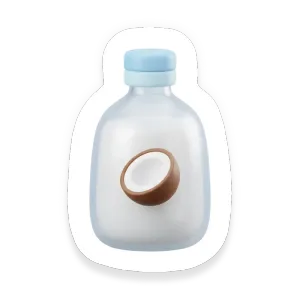
Coconut Oil
Oil
Last updated July 5, 2026. The Tummi Food Team maintains this Can I Feed This safety guide guide. Supporting links appear in Sources when available.



Clinically reviewed by Andria Procopio and Arefa Mohamed
Direct answer
Can babies eat Coconut Oil?
Yes, coconut oil can be introduced around 6 months when starting solids, prepared in appropriate amounts. It is safe and nutritious for babies.
- Serve Age6+months
Most babies start solids around 6 months once they show readiness signs. Match the texture and serving size to your baby's skills.
- No Allergens
Coconut Oil is not flagged as one of the major allergens tracked in this database. Still watch your baby closely when serving any new food.
- Choking Risk123451
Lower choking risk when served in the right texture. Always supervise meals and adjust the shape for your baby.
This guide is for everyday food prep questions. Ask your pediatrician about medical concerns, feeding delays, allergy plans, or serious reactions.
How Do You Serve Coconut Oil?
How to serve Coconut Oil to babies 6 months and older
- 1Start with a very small amount (about 1/4 teaspoon) mixed into a spoonful of puree or warm sauce so the flavor and texture are gentle.
- 2Make sure the oil is fully liquid — warm a small jar in a bowl of warm water or stir it into warm food. Avoid solid pieces, which can increase choking risk.
- 3Use it for cooking, baking, or a tiny smear on the tray to taste; keep portions small because coconut oil is high in fat.
- 4Introduce it alone once and watch for any reaction over 48–72 hours; consult your pediatrician if there's a family history of food allergies.
- 5Always supervise during feeding and serve soft, smooth textures to reduce choking hazards.
How to serve Coconut Oil to babies 12 months and older
- 1Use coconut oil in dressings, marinades, and family meals for cooking and baking so your child can taste familiar flavors as part of regular meals.
- 2Offer small amounts mixed into a variety of foods rather than on its own to encourage acceptance and nutritional variety.
- 3Always make sure the oil is fully liquid and evenly mixed before serving—solid lumps can be a choking hazard.
- 4Supervise closely at mealtimes and include coconut oil as one part of a balanced diet, not as a primary food.
Is Coconut Oil a Common Allergen?
FDA guidance no longer classifies coconut as a required “tree nut” allergen for labeling, but coconut (and coconut oil) still contains proteins that can cause allergic reactions in some people. Coconut allergy is uncommon and many people with tree‑nut allergies tolerate coconut, though cross‑reactions can occur. Parents should watch for symptoms on first exposures, consult an allergist if concerned, and always read product labels and contact manufacturers when in doubt.
Is Coconut Oil a Choking Hazard?
Very Low Choking Risk
Coconut oil in liquid form presents a low choking risk, but it hardens when cool and solid pieces can pose an increased choking hazard. Parents should be mindful of any hardened pieces and closely supervise babies during meals, staying within arm’s reach. Learn the signs of choking and basic infant first-aid so you can respond quickly if needed.
Have More Questions?
It depends. Coconut oil can be stored in an airtight container at room temperature for up to a year, but for best freshness, keep it in a cool, dark place and check for signs of rancidity before use.
It depends. Freezing coconut oil in small portions, like in ice cube trays, allows for easy thawing and prevents waste, especially when using it in recipes or for topical application.
It depends. Choosing organic coconut oil may reduce exposure to pesticides and contaminants, but conventional options are also safe, provided they are high quality and food-grade.
It depends. Combining coconut oil with other healthy fats, like avocado or olive oil, can diversify your baby's nutrient intake and support development.
It depends. Portion sizes for babies should be small, such as a teaspoon or less, gradually increasing as tolerated, always considering your child's appetite and dietary needs.
Save Coconut Oil to your food log
Track foods, reactions, and prep notes in Tummi when you want to keep your baby's feeding history in one place.
Sources
- U.S. Food & Drug Administration. FDA Basics for Industry: Section 201(qq). fda.gov
- Anagnostou, K. (2017). Coconut Allergy Revisited. Children (Basel, Switzerland), 4(10):85. doi.org
- Michavila GA, Amat BM, Gonzalez CM, Segura NL, Moreno PM, Bartolomé B. (2015). Coconut anaphylaxis: Case report and review. Allergologia et immunopathologia. 43(2):219.
- Kim KT, Hussain H. (1999). Prevalence of food allergy in 137 latex-allergic patients. Allergy Asthma Proc. 20(2):95-7.
What Other Oil Can Babies Eat?
See all →
Source-Linked Guidance
See the evidence behind the guide.
Food guides show direct links to public-health guidance and research when supporting references are available. Source inclusion does not imply endorsement.
 Centers for Disease Control and Prevention
Developmental milestones, nutrition guidelines, and allergen introduction timelines.
 American Academy of Pediatrics
Evidence-based feeding recommendations from the leading pediatric authority.
 National Institutes of Health
Peer-reviewed research on infant nutrition, allergies, and food safety.