
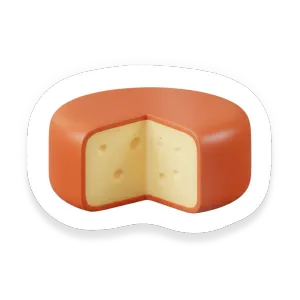
Edam Cheese
Dairy
Last updated July 5, 2026. The Tummi Food Team maintains this Can I Feed This safety guide guide. Supporting links appear in Sources when available.



Clinically reviewed by Andria Procopio and Arefa Mohamed
Direct answer
Can babies eat Edam Cheese?
Yes, babies can eat edam cheese from around 6 months of age when they are ready for solids; choose pasteurized varieties and serve in safe, small pieces.
- Serve Age6+months
Most babies start solids around 6 months once they show readiness signs. Match the texture and serving size to your baby's skills.
- Allergens
Edam Cheese is flagged for milk. Introduce common allergens in a baby-safe form and follow your clinician's advice if your baby is higher risk.
- Choking Risk123453
Some choking risk. Use the prep section to change the size, shape, or texture before serving.
This guide is for everyday food prep questions. Ask your pediatrician about medical concerns, feeding delays, allergy plans, or serious reactions.
How Do You Serve Edam Cheese?
How to serve Edam Cheese to babies 6 months and older
- 1Use only pasteurized Edam and avoid raw/unpasteurized varieties.
- 2Cut cheese into thin, flat strips that are easy for a baby to grasp — do not serve cubes or large chunks.
- 3If warming or melting, sprinkle a small amount of shredded cheese on food rather than creating large melted blobs; keeps textures manageable.
- 4Always supervise while eating and ensure the baby is sitting upright; stop feeding if pieces break into small, hard fragments.
How to serve Edam Cheese to babies 12 months and older
- 1Serve pasteurized Edam in small, easy-to-chew forms like thin shreds or short strips torn from a thin slice.
- 2Grate the cheese and mix it into warm foods (e.g., pasta or mashed vegetables) so it breaks into tiny pieces. Reduces choking risk.
- 3Avoid firm cubes, large slices, or big melted globs (such as large pizza blobs) that can be hard to swallow.
- 4Always offer cheese while seated and supervised, and adjust piece size to match your child’s chewing ability.
How to serve Edam Cheese to babies 18 months and older
- 1Always remove the wax and any non-food wrapping before offering the cheese.
- 2Serve the cheese whole only while the child is seated and closely supervised — within arm’s reach so you can intervene quickly if needed.
- 3Model taking small bites and encourage thorough chewing; offer a small piece first to check readiness.
- 4Avoid giving cheese when the child is walking, running, or distracted — cut into pieces if you’re concerned about choking.
Is Edam Cheese a Common Allergen?
Edam is a semi‑hard cheese made from cow’s milk and contains milk proteins (casein), so it is not safe for anyone with a cow’s‑milk allergy. It is often lower in lactose than fresh cheeses, so some people with lactose intolerance may tolerate small amounts, but it still contains milk and is not lactose‑free. Always check product labels for added ingredients or cross‑contact warnings, and consult your pediatrician or an allergist before offering to infants or anyone with a history of severe milk allergy.
Is Edam Cheese a Choking Hazard?
Moderate Choking Risk
Edam cheese can be a choking hazard: its firm texture and tendency to form sticky, cohesive masses in the mouth can block the airway. When introducing it, stay within arm’s reach and supervise closely so you can act if baby gags or chokes. Be familiar with the signs of choking and keep your infant choking first-aid skills up to date.
Have More Questions?
Yes, edam cheese can be introduced to babies around 6 months old when they are starting solids. Ensure it is pasteurized to minimize health risks.
It depends. While edam cheese can be high in sodium, giving small amounts occasionally as part of a varied diet is generally fine for babies.
Yes, edam cheese, made from cow’s milk, is a common allergen. It’s best to observe your baby for any allergic reactions when first introducing.
Yes, edam cheese can be a choking hazard for babies due to its firm texture. Serve it in small, age-appropriate pieces and supervise feeding.
It depends. Small, wax-wrapped Edam cheeses like Babybel are better suited for toddlers over 18 months, with appropriate supervision and preparation.
Save Edam Cheese to your food log
Track foods, reactions, and prep notes in Tummi when you want to keep your baby's feeding history in one place.
Sources
- Dangers of raw milk - U.S. Food & Drug Administration fda.gov
- Consumption of raw or unpasteurized milk and milk products by pregnant women and children (AAP, Pediatrics 2014) pediatrics.aappublications.org
- Avoidance of added salt for 6-12-month-old infants: A narrative review (Archives de pediatrie, 2023) sciencedirect.com
- Infants' and Children's Salt Taste Perception and Liking: A Review (Nutrients, 2017) mdpi.com
- Sodium: Too Much of a Good Thing (National Capital Poison Center, 2013) poison.org
- Does salt intake in the first two years of life affect cardiovascular risk? (Nutr Metab Cardiovasc Dis, 2012) doi.org
- Modeling the growth of Listeria monocytogenes on cheese (Frontiers in Cellular and Infection Microbiology, 2014) frontiersin.org
- Listeria infections - KidsHealth (2017) kidshealth.org
- Foods to avoid giving babies and young children - NHS (2018) nhs.uk
- Cheese Microbial Risk Assessments - A Review (Asian-Australasian Journal of Animal Sciences, 2016) doi.org
- The epidemiology of milk allergy in US children (Annals of Allergy, Asthma & Immunology, 2013) doi.org
- The challenge of cow milk protein allergy (Small Ruminant Research, 2007) doi.org
- Cow’s milk protein allergy - GI Kids (2019) gikids.org
- Histamine Intolerance in Children: A Narrative Review (Nutrients, 2021) mdpi.com
- Histamine Intolerance: The Current State of the Art (Biomolecules, 2020) mdpi.com
- Food protein-induced enterocolitis syndrome and allergic proctocolitis (Allergy Asthma Proc., 2015) doi.org
- Living with lactose intolerance (InformedHealth/IQWiG, 2010) informedhealth.org
What Other Dairy Can Babies Eat?
See all →
Source-Linked Guidance
See the evidence behind the guide.
Food guides show direct links to public-health guidance and research when supporting references are available. Source inclusion does not imply endorsement.
 Centers for Disease Control and Prevention
Developmental milestones, nutrition guidelines, and allergen introduction timelines.
 American Academy of Pediatrics
Evidence-based feeding recommendations from the leading pediatric authority.
 National Institutes of Health
Peer-reviewed research on infant nutrition, allergies, and food safety.