
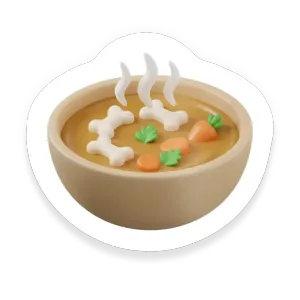
Bone Broth
Meat
Last updated July 5, 2026. The Tummi Food Team maintains this Can I Feed This safety guide guide. Supporting links appear in Sources when available.



Clinically reviewed by Andria Procopio and Arefa Mohamed
Direct answer
Can babies eat Bone Broth?
Bone broth can be introduced as an ingredient in meals from around 6 months, once the baby shows the developmental signs of readiness for complementary foods. Choose broth with no added salt, strain out bones and solids, and keep breast milk or first infant formula as the main drink during the first year.
- Serve Age6+months
Most babies start solids around 6 months once they show readiness signs. Match the texture and serving size to your baby's skills.
- No Allergens
Bone Broth is not flagged as one of the major allergens tracked in this database. Still watch your baby closely when serving any new food.
- Choking Risk123451
Lower choking risk when served in the right texture. Always supervise meals and adjust the shape for your baby.
This guide is for everyday food prep questions. Ask your pediatrician about medical concerns, feeding delays, allergy plans, or serious reactions.
How Do You Serve Bone Broth?
How to serve Bone Broth to babies 6 months and older
- 1Use bone broth mainly as a cooking ingredient—stir into purees, savory porridges, mashed vegetables, or grains to add gentle flavor and extra moisture.
- 2If offered as a drink, serve only small amounts (about 60–120 mL / 2–4 oz) in an open cup at mealtimes; do not use a bottle.
- 3Keep breast milk or formula as the main source of nutrition and offer broth sparingly rather than as a meal replacement.
- 4Prefer low-sodium or homemade broth with no added salt. If using store-bought, dilute with water to reduce salt and skim off fat after cooling.
- 5Strain well and serve lukewarm; avoid bone fragments or large pieces and check labels for added spices or allergens before offering.
How to serve Bone Broth to babies 12 months and older
- 1Offer broths and stocks freely in cooking and as a drink; serve in a cup or with a spoon and allow larger portions than for infants.
- 2Choose low-sodium or unsalted broths and avoid highly salted commercial versions. Check labels and dilute if needed before serving.
- 3Make sure broths are fully cooked and well strained to remove small bones and solids, then cool to a safe temperature before serving.
- 4Introduce broths alongside other solid foods and watch for any reactions; store leftovers promptly in the fridge and reheat until steaming hot before serving.
Is Bone Broth a Common Allergen?
Plain bone broth made from beef, chicken, or pork bones generally does not contain common allergens (milk, egg, peanut, tree nuts, soy, wheat/gluten, sesame, shellfish, fish) unless those ingredients are added or cross-contact occurs. Broths made from fish or shellfish will contain fish/shellfish allergens. Commercial or restaurant broths can include soy, wheat-containing flavorings (e.g., soy sauce, bouillon), dairy, or other additives—always read labels and ask about ingredients. If your child has a known allergy, avoid broths made from that allergen and choose single-ingredient, low-sodium homemade broth or verified allergen-free brands.
Is Bone Broth a Choking Hazard?
Very Low Choking Risk
Bone broth poses a low choking risk when it’s free of large solids, but any food or liquid can lead to choking in rare cases. Always stay within arm’s reach and closely observe your baby during meals so you can respond quickly if they gag or cough. If you have concerns about your baby’s swallowing or gagging, consult your pediatrician or a feeding specialist.
Have More Questions?
Bone broth can be used as a cooking ingredient from around 6 months, once your baby shows the developmental signs of readiness for complementary foods. Choose broth with no added salt; breast milk or first infant formula should remain the main drink during the first year, with water offered in a cup at meals.
Bone broth may add liquid and flavour to a baby's meal, but it should not be relied on as a main source of nutrition. During the first year, breast milk or first infant formula should remain the main drink and an important source of energy and nutrients.
Bone broth made from meat is not one of the nine major food allergens, but the finished broth may contain major allergens from its ingredients. Fish or crustacean shellfish broth contains a major allergen, and packaged broth should be checked for ingredients such as milk, wheat, soy or sesame.
Bone broth can be offered as an ingredient once a baby is ready for complementary foods, provided it has no added salt and is fully strained to remove bones and other solids. Cool it before serving and supervise your baby throughout the meal.
Bone broth should not be relied on to hydrate a sick baby. Continue breast or formula feeds, offering smaller feeds more often if the baby is vomiting, and seek urgent medical advice for a baby under 12 months if you are worried, feeding stops, fluids cannot be kept down or signs of dehydration appear.
Save Bone Broth to your food log
Track foods, reactions, and prep notes in Tummi when you want to keep your baby's feeding history in one place.
Sources
- Alpha-gal and Red Meat Allergy - American Academy of Allergy, Asthma & Immunology aaaai.org
- Meat allergy and allergens - Wilson & Platts-Mills (Molecular Immunology, 2018) pmc.ncbi.nlm.nih.gov
- Severe allergy to chicken meat - Zacharisen MC (WMJ, 2006) pubmed.ncbi.nlm.nih.gov
What Other Meat Can Babies Eat?
See all →

Source-Linked Guidance
See the evidence behind the guide.
Food guides show direct links to public-health guidance and research when supporting references are available. Source inclusion does not imply endorsement.
 Centers for Disease Control and Prevention
Developmental milestones, nutrition guidelines, and allergen introduction timelines.
 American Academy of Pediatrics
Evidence-based feeding recommendations from the leading pediatric authority.
 National Institutes of Health
Peer-reviewed research on infant nutrition, allergies, and food safety.