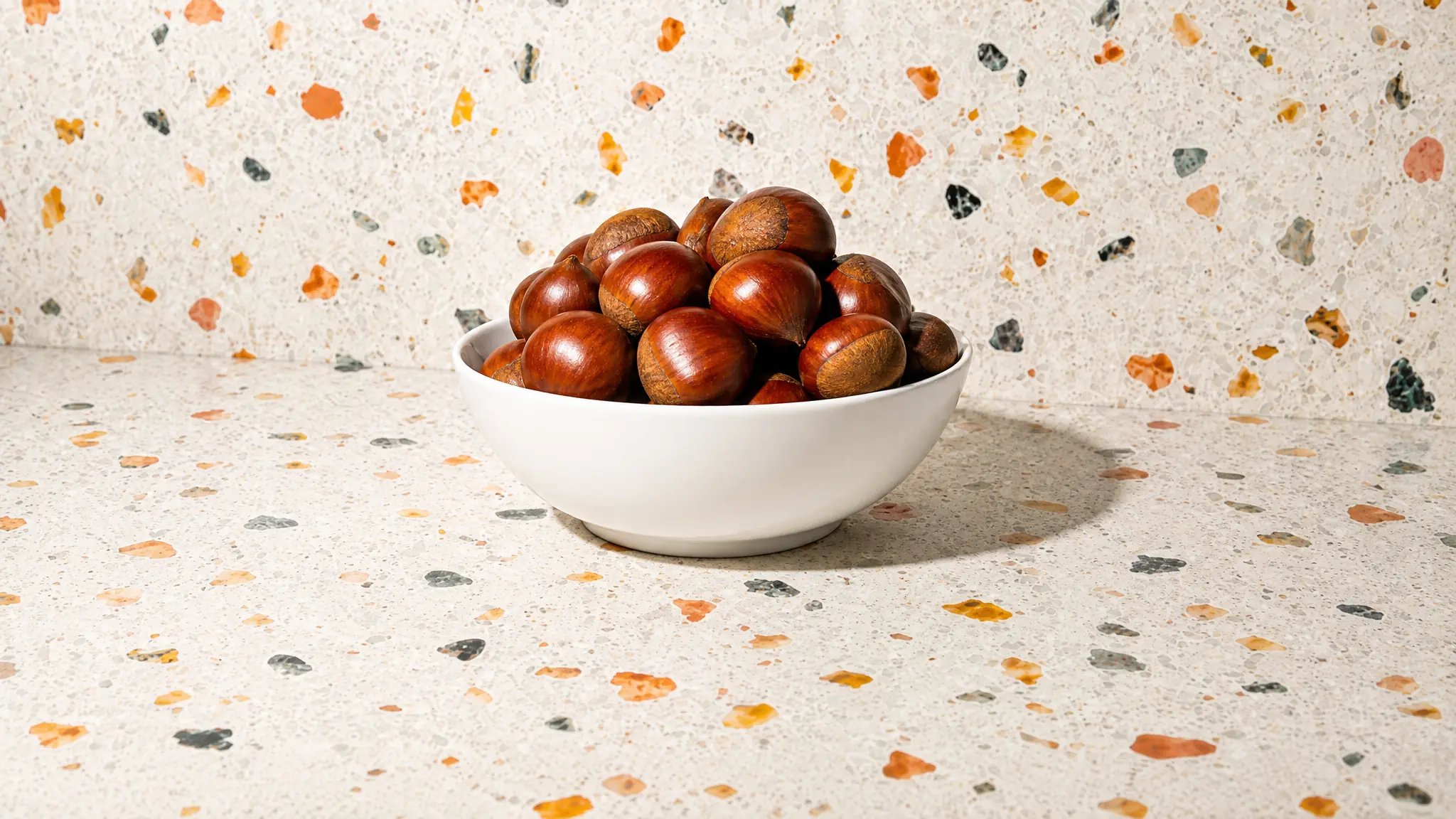
Chestnut
Treenut
Last updated July 5, 2026. The Tummi Food Team maintains this Can I Feed This safety guide guide. Supporting links appear in Sources when available.



Clinically reviewed by Andria Procopio and Arefa Mohamed
Direct answer
Can babies eat Chestnut?
Yes, cooked chestnut may be introduced around 6 months once your baby is developmentally ready for complementary foods. Mash or puree it to an appropriate texture, and do not offer whole or chopped chestnuts because they are choking hazards.
- Serve Age6+months
Most babies start solids around 6 months once they show readiness signs. Match the texture and serving size to your baby's skills.
- No Allergens
Chestnut is not flagged as one of the major allergens tracked in this database. Still watch your baby closely when serving any new food.
- Choking Risk123455
Higher choking risk. Watch the prep steps closely, especially because this food can be small and round, hard, and fibrous or stringy.
This guide is for everyday food prep questions. Ask your pediatrician about medical concerns, feeding delays, allergy plans, or serious reactions.
How Do You Serve Chestnut?
How to serve Chestnut to babies 6 months and older
- 1Fully cook and peel chestnuts, removing all inner and outer skins; grind or blend with a small amount of water, breast milk, or formula until there are no large pieces and you have a smooth, saucy paste.
- 2Aim for a lump-free, spoonable texture that can be stirred into purees or soft foods, and always test temperature before offering.
- 3Because chestnuts are high in fiber, introduce them slowly — start with a teaspoon and increase gradually over several days. Consult a pediatrician if you see persistent gas, rash, vomiting, or breathing changes.
- 4Avoid candied, whole, or firm pieces; these increase choking risk and should not be given.
How to serve Chestnut to babies 12 months and older
- 1Use pre-cooked chestnuts; slice them very thinly or press/flatten so they break into small, soft pieces that crumble easily under light pressure.
- 2If any pieces remain firm, finely grind or mash them until there are no hard bits.
- 3Chestnut paste or nut butter can be offered without thinning—spread a thin layer on bread or fruit and always provide a drink to help with sticky bits.
- 4Avoid whole, large, or candied chestnuts and any sticky toppings that might increase choking risk.
How to serve Chestnut: Varies
- 1Cook chestnuts fully (roast, boil, or steam) until soft, then peel both the outer shell and inner skin while warm to remove choking hazards.
- 2Cut or mash chestnuts into small, easy-to-chew pieces before serving so children can handle them safely.
- 3Offer only a few pieces at a time and model taking small bites and chewing slowly.
- 4Always supervise closely and stay within arm’s reach while eating. Remove food immediately if you notice gagging or coughing.
- 5Avoid sticky or whole candied chestnuts; reserve sweet preparations for children who reliably chew and swallow small, soft pieces.
Is Chestnut a Common Allergen?
Chestnuts are botanically tree nuts and can cause allergic reactions in people with tree‑nut allergies, though not everyone with a tree‑nut allergy will react to chestnuts. Water chestnuts are unrelated and are usually safe for those with tree‑nut allergies. Because cross‑reactivity varies and processed products may be contaminated with other tree nuts, check labels and consult your child’s allergist before offering chestnuts. If your child has a history of severe or multiple food allergies, treat chestnuts as potentially risky and carry emergency medication as advised.
Is Chestnut a Choking Hazard?
High Choking Risk
Chestnuts are firm, round, and can be slippery, chewy, or crumbly—qualities that increase their choking risk for young children. Be especially cautious when first introducing them: stay within arm’s reach, keep mealtimes calm and seated, and watch closely for signs of choking. Know infant/toddler choking first aid or have someone trained nearby in case you need it.
Have More Questions?
No. Do not offer whole or chopped chestnuts to a baby because these forms are choking hazards. From around 6 months, once your baby is developmentally ready for complementary foods, offer chestnut mashed or pureed to an appropriate texture instead.
Yes, chestnuts can be included as one food in a varied complementary diet. Prepare them in a texture suited to your baby's developmental abilities, such as mashed or pureed when starting solids.
Chestnut is not classified by the FDA as a major food allergen for U.S. labeling, but it can still cause an allergic reaction. A child with latex allergy may have a greater risk of reacting to European chestnut, so seek individualized advice from the child's allergy clinician before introduction in that situation.
Yes. Whole or chopped chestnuts are choking hazards for babies and young children. Mash or puree chestnut to a texture suited to your child's developmental abilities.
Smooth, unsweetened chestnut paste may be introduced around 6 months once your baby is developmentally ready for complementary foods. Thin it to an appropriate consistency or mix it into soft food rather than offering a thick spoonful, and check packaged paste for added sugar.
Save Chestnut to your food log
Track foods, reactions, and prep notes in Tummi when you want to keep your baby's feeding history in one place.
Sources
- Changes Induced by Pressure Processing on Immunoreactive Proteins of Tree Nuts (Cuadrado et al., Molecules, 2020) mdpi.com
- Cross-reactivity Syndromes in Food Allergy (García & Lizaso, 2011) jiaci.org
- Oral Allergy Syndrome Induced by Chestnut (Antico, Ann Allergy Asthma Immunol, 1996) doi.org
- Latex allergy (Slater, J Allergy Clin Immunol, 1994) doi.org
- Differential allergen sensitization patterns in chestnut allergy (Sánchez-Monge et al., J Allergy Clin Immunol, 2006) doi.org
- Sugar in Infants, Children and Adolescents: A Position Paper (Fidler Mis et al., ESPGHAN Committee on Nutrition, 2017) pubmed.ncbi.nlm.nih.gov
- Added Sugar and Dental Caries in Children (Chi & Scott, Dent Clin North Am, 2019) pmc.ncbi.nlm.nih.gov
- WHO Guideline for complementary feeding of infants and young children 6–23 months of age (WHO, 2023) who.int
What Other Treenut Can Babies Eat?
See all →


Source-Linked Guidance
See the evidence behind the guide.
Food guides show direct links to public-health guidance and research when supporting references are available. Source inclusion does not imply endorsement.
 Centers for Disease Control and Prevention
Developmental milestones, nutrition guidelines, and allergen introduction timelines.
 American Academy of Pediatrics
Evidence-based feeding recommendations from the leading pediatric authority.
 National Institutes of Health
Peer-reviewed research on infant nutrition, allergies, and food safety.