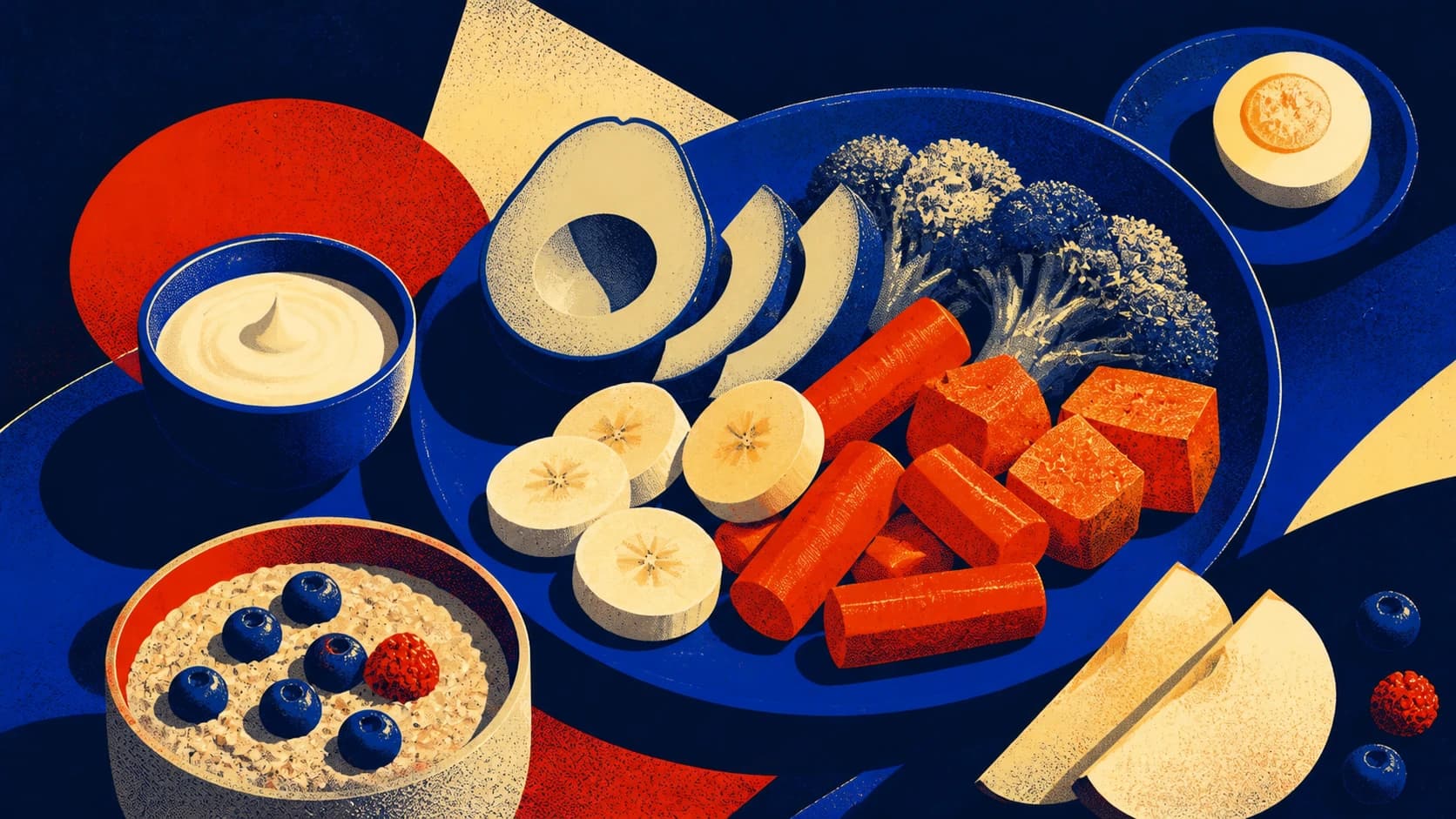
If your baby has cycled through banana, avocado, carrot, and sweet potato this week, your kitchen is in familiar company. Fruits and vegetables occupy a large part of the most widely recorded foods in Tummi, even if the high chair tray rarely looks as organized as the list.
We took the existing ranking of ten foods and asked a narrower question about its composition. Instead of treating every item as an isolated winner, we classified which places belonged to fruits and vegetables and which belonged to foods from other groups.
Produce clearly leads this ranking, but the wording matters. Seven places in a top ten is not the same as 70 percent of a diet, and a food's position does not reveal portion size or repeat servings. This report separates what the classification shows from what it cannot support.
Key Findings
- Seven of the ten most widely recorded foods were fruits or vegetables.
- Four of the top five were produce: banana, avocado, carrot, and sweet potato.
- Banana ranked first, while avocado and carrot ranked third and fourth.
- Egg was the highest-ranked food outside the produce groups, placing second overall.
- Yogurt and oatmeal supplied the remaining two non-produce places in the top ten.
How much of the top ten is produce?
Banana, avocado, carrot, sweet potato, apple, broccoli, and strawberry account for seven positions. Four sit inside the top five, which means produce is concentrated near the top as well as spread across the full ranking.
Egg, yogurt, and oatmeal are the three foods outside the fruit and vegetable groups. Their presence makes the result more useful than a simple produce list, because it shows that the foods with broad reach also include a common allergen, a dairy food, and a grain food.
- 01Banana50.2%
- 02Egg43.2%
- 03Avocado42.3%
- 04Carrot41.7%
- 05Sweet potato39.9%
- 06Apple36.0%
- 07Yogurt28.2%
- 08Broccoli27.9%
- 09Oats and oatmeal27.6%
- 10Strawberry27.2%
Source: Aggregated Tummi product data. Records from January 1 to August 18, 2026.
Does seven of ten mean produce made up most of every diet?
No. Seven of ten describes the composition of a ranked list. It does not describe the share of all food occurrences, the share of meals, or the share of calories. Those are different denominators that would require different analyses.
A family could record banana once and another food many times, yet banana still contributes one reached profile. The ranking is designed to show breadth across profiles, so it deliberately does not give extra weight to repeated records from the same family.
Which fruits and vegetables rank highest?
Banana leads the entire list, followed among produce by avocado, carrot, and sweet potato. Apple sits sixth, broccoli eighth, and strawberry tenth. The produce foods therefore include fruit and vegetables rather than one narrow category.
The data supports an ordering, not an explanation. It does not tell us whether a food ranked highly because it was easier to prepare, more available, less expensive, more familiar, or better accepted. Those possibilities may sound reasonable, but this study did not measure them.
What do egg, yogurt, and oatmeal add to the picture?
Egg ranks second, higher than every produce food except banana. Yogurt ranks seventh and oatmeal ninth. Together they show that broad reach is not limited to fruits and vegetables during the 6 to 12 month period covered by the analysis.
The three foods should not be treated as a complete summary of protein, dairy, or grains. They are individual foods that crossed the top-ten threshold. Other foods from those groups may be common inside some profiles without reaching enough profiles to enter this particular ranking.
Why compare the ranking with infant food categories?
The Feeding Infants and Toddlers Study in the United States and the 2024 Infant Feeding Survey in England organize infant-feeding information around foods and broader categories. They provide outside context for asking how infant diets are composed, but they are not interchangeable with product data.
Tummi meals are entered by self-selected caregivers as part of daily app use. A survey can ask a standardized question across a designed sample, while product data reflects what a caregiver chooses to record. Both can illuminate eating patterns, but their percentages answer different questions.
What disappears when foods are reduced to categories?
A primary category makes a clean chart possible, but real meals are less tidy. Yogurt might be served with fruit, oatmeal might contain several ingredients, and a mixed dish might cross more than one food group. This top-ten classification does not reconstruct recipes.
It also does not measure nutritional quality. A fruit or vegetable label says what kind of food was recorded, not whether the meal met a need, supplied a particular nutrient, or matched a recommended balance. Those interpretations require information this ranking does not contain.
Methodology and limitations
This report uses the same meal records as the top-food ranking. The records cover January 1 through August 18, 2026 and eligible baby profiles ages 6 to 12 months.
Foods are ranked by the share of eligible profiles with at least one record. Each food contributes at most once per profile, regardless of how often it was recorded there.
The produce count is based on each food's primary category in the Can I Feed This food library. Banana, avocado, apple, and strawberry are classified as fruit. Carrot, sweet potato, and broccoli are classified as vegetables.
The resulting seven-of-ten statement describes places in the ranking. It does not estimate the proportion of all meals, occurrences, portions, calories, or nutrients represented by produce.
The cohort is self-selected and reflects how families record meals in Tummi. The two outside dietary surveys listed as sources offer context only, since their populations, methods, time frames, and definitions differ.
The dataset is self-selected because it describes families who chose to use Tummi. The findings describe aggregated app activity and are not population estimates for every family, baby, or country.
Everything shown here is aggregated. No names, individual profiles, free-text answers, or personal meal histories are published.
Conclusion
Fruits and vegetables do lead the recorded top ten. They hold seven positions, including four of the top five, and they range from banana at the top to strawberry in tenth place. In that specific sense, produce shapes the list.
The three remaining foods keep the result from collapsing into a simple fruit-and-vegetable story. Egg ranks second, while yogurt and oatmeal add dairy and grain foods to the picture of broad reach across profiles.
The durable boundary is the denominator. This is a classification of ten widely recorded foods, not a reconstruction of every plate. It shows what crossed the most profiles, while leaving frequency, portions, intake, nutrition, and the reasons behind each choice unmeasured.
Frequently Asked Questions
Does this mean babies mostly eat produce?
No. It means produce occupies seven places in the top-ten ranking by profile reach. This report does not calculate produce as a share of every meal or every baby's diet.
Why might produce appear so often?
The data cannot establish a cause. Preparation, familiarity, availability, texture, and preference were not measured, so the report does not rank explanations.
Are mixed dishes included in this top ten?
The figure ranks named foods in the current dataset. It does not unpack every ingredient inside mixed dishes or assign those ingredients separate places.
Can this ranking assess a balanced diet?
No. It does not include portions, calories, nutrients, breast milk, formula, or the full composition of meals, so it cannot evaluate dietary balance.
Sources
- Tummi Food Team, 2026. Aggregated Tummi feeding records and onboarding responses. First-party product data.
- Feeding Infants and Toddlers Study 2016. A national U.S. dietary study used here as context for common infant food categories.
- Infant Feeding Survey 2024. England survey tables covering foods eaten and feeding patterns during infancy.