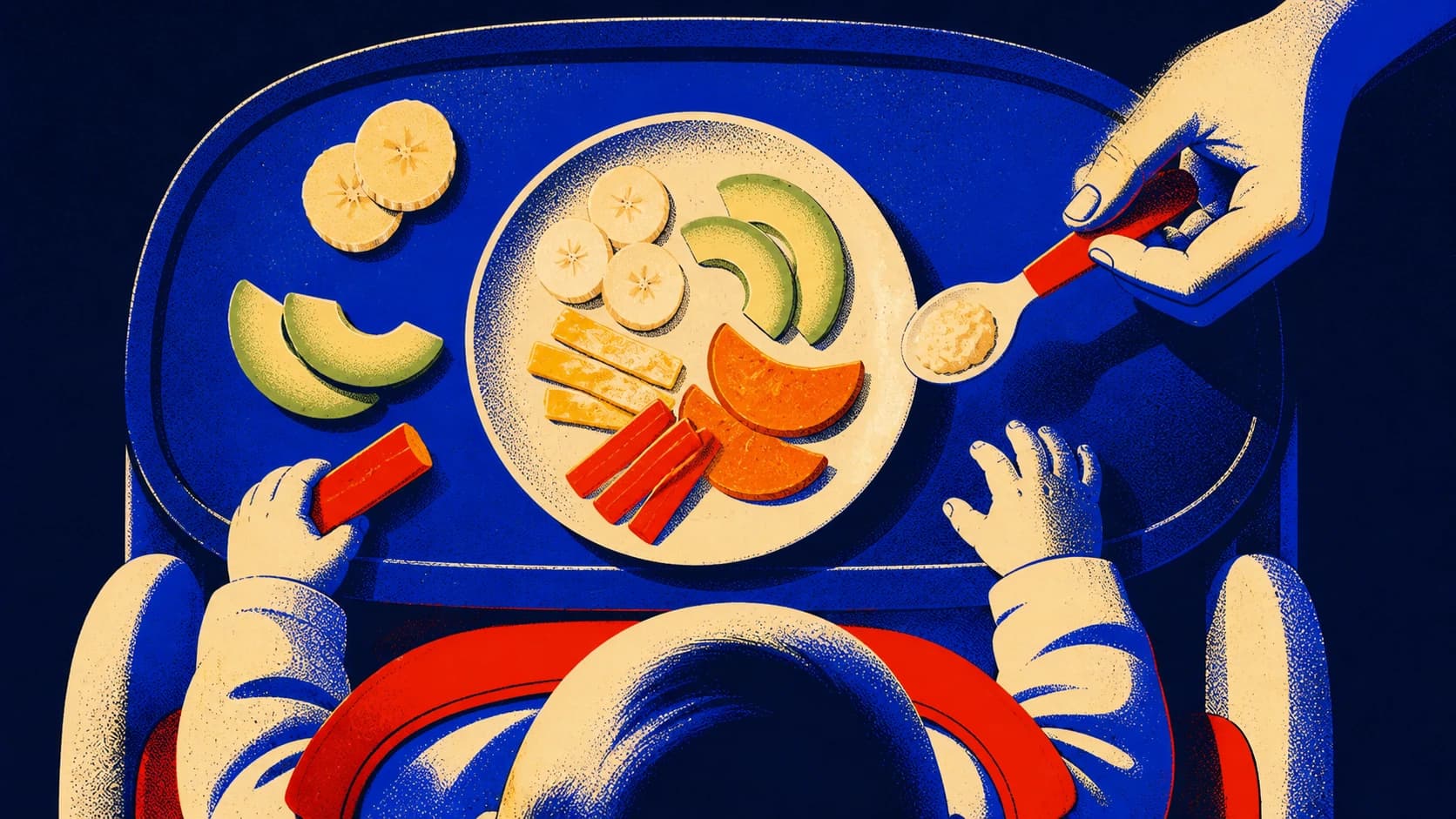
Starting solids can turn an ordinary banana into a tiny research project. You wonder whether other babies are eating the same foods, whether your rotation is varied enough, and whether everyone else has quietly figured out a menu that you somehow missed.
Tummi records offer one way to look past the polished meal photos and see what caregivers actually entered at mealtime. We analyzed meal entries from baby profiles ages 6 to 12 months, then ranked foods by the share of eligible profiles in which each food appeared at least once.
The result is a record of reach, not a prescription. It cannot tell us how large a serving was, how much a baby swallowed, or why a caregiver chose one food over another. It can tell us which foods traveled across the broadest part of this group of Tummi families.
Key Findings
- Banana reached the widest share of eligible profiles, appearing in about half.
- Egg ranked second, followed closely by avocado and carrot.
- The top five also included sweet potato, another familiar produce food.
- Seven of the ten most widely recorded foods were fruits or vegetables.
- Yogurt and oatmeal joined egg as the three top-ten foods outside the fruit and vegetable groups.
Which foods reached the widest share of baby profiles?
Banana led the ranking, appearing in 50.2 percent of eligible profiles. Egg followed at 43.2 percent, with avocado at 42.3 percent and carrot at 41.7 percent. Sweet potato completed the top five at 39.9 percent.
Apple, yogurt, broccoli, oatmeal, and strawberry filled the remaining places. The distance between first and tenth was meaningful, but the chart is not a count of meals. It shows whether each food appeared anywhere in a profile during the study window.
- 01Banana50.2%
- 02Egg43.2%
- 03Avocado42.3%
- 04Carrot41.7%
- 05Sweet potato39.9%
- 06Apple36.0%
- 07Yogurt28.2%
- 08Broccoli27.9%
- 09Oats and oatmeal27.6%
- 10Strawberry27.2%
Source: Aggregated Tummi product data. Records from January 1 to August 18, 2026.
What does banana's lead actually tell us?
Banana appeared in roughly one out of every two eligible profiles, which made it the broadest-reaching food in this analysis. That finding is easy to understand as popularity, but the measure is narrower: a profile counts once whether banana was recorded one time or every morning.
The data does not record the reason for the choice. Familiarity, preparation, availability, texture, cost, and a baby's response could all matter in real kitchens, but none of those explanations was measured. The supported claim is simply that banana appeared across more profiles than any other food.
Why does egg stand out in a produce-heavy list?
Egg was the only food outside the fruit and vegetable groups in the top five, and it ranked second overall. Its position puts a common allergen food beside the produce foods that otherwise define the upper part of the list.
This ranking does not establish when egg was first introduced, how it was served, or whether it was tolerated. Those questions belong to the separate allergen analysis. Here, egg is counted only as a named food that appeared somewhere in a baby's recorded meals during the study window.
How strongly do fruits and vegetables shape the top ten?
Banana, avocado, carrot, sweet potato, apple, broccoli, and strawberry occupied seven of the ten positions. Four of those foods sat in the top five, so produce was present not only throughout the ranking but near its top.
Egg, yogurt, and oatmeal kept the list from being produce-only. Their presence matters because a ranking of individual foods can otherwise look more uniform than the actual set of recorded meals. Even so, seven places in a top ten does not mean produce represented 70 percent of every recorded food.
How does this list relate to broader infant-feeding research?
The Feeding Infants and Toddlers Study and the 2024 Infant Feeding Survey in England provide broader context for foods and food categories reported during infancy. They use different samples and methods, so their tables should not be merged with Tummi percentages or treated as a direct replication.
Their role here is to show the kind of question being asked elsewhere: which foods and categories appear in infant diets. Tummi adds a product-data view based on caregiver records over time. That view is timely and detailed, but it is also self-selected and tied to how families use the app.
What can this ranking never show on its own?
A food can rank highly because it reached many profiles, yet the chart cannot say whether it was served frequently inside those profiles. It cannot distinguish a taste from a meal, a favorite from a refusal, or a spoonful swallowed from a serving spread across the floor.
It also cannot evaluate nutritional balance. Breast milk, formula, calories, portions, nutrients, and the complete composition of mixed dishes are outside this comparison. The ranking is useful when it stays attached to its denominator: eligible profiles with at least one record for a food.
Methodology and limitations
This report uses the meal records included in the existing top-food analysis, dated January 1 through August 18, 2026. The ranking covers eligible baby profiles ages 6 to 12 months.
For this ranking, each named food is counted once per eligible profile. Repeated banana records inside one profile do not increase banana's reach. This prevents very active recorders from determining the order through repetition alone.
The percentages describe the share of eligible profiles that recorded each food at least once. They do not measure meal frequency, serving size, calories, nutrients, acceptance, or the amount swallowed.
Tummi families are self-selected app users. The findings describe activity inside this cohort and are not estimates for all babies, families, countries, or feeding approaches.
The outside studies listed with the figure are used only as context. Their survey designs, populations, periods, and food definitions differ from this product-data analysis, so no direct statistical comparison is made.
The dataset is self-selected because it describes families who chose to use Tummi. The findings describe aggregated app activity and are not population estimates for every family, baby, or country.
Everything shown here is aggregated. No names, individual profiles, free-text answers, or personal meal histories are published.
Conclusion
The most widely recorded foods are strikingly ordinary. Banana leads, egg interrupts a produce-heavy top five, and avocado, carrot, sweet potato, apple, yogurt, broccoli, oatmeal, and strawberry complete a list that could plausibly be found in many family kitchens.
That familiarity is the report's clearest result. It is not evidence that one menu is correct, and it is not a checklist for your baby. It is a bounded answer to a simple question: across this group of Tummi profiles, these were the foods that appeared most widely.
The chart becomes less useful when reach is mistaken for intake. Read it as a map of foods caregivers recorded, then leave room for all the details the dataset cannot see, including the portion, the reaction, the repeat serving, and the very real possibility that the floor ate well too.
Frequently Asked Questions
Does most recorded mean most eaten?
No. The ranking measures how many eligible profiles recorded a food at least once. It does not measure portions, repeat servings, or the amount swallowed.
Should every baby eat these ten foods?
No. This is a descriptive snapshot of Tummi activity, not a feeding checklist. Foods and serving forms should fit your baby's readiness and individual needs.
Are these the most common first foods?
Not necessarily. The study covers records from ages 6 to 12 months and ranks reach across the full window. It does not isolate each baby's first recorded food.
Does the ranking account for repeated meals?
Repeated records do not increase a food's profile reach. A food counts once for a profile whether it was recorded once or many times during the study window.
Sources
- Tummi Food Team, 2026. Aggregated Tummi feeding records and onboarding responses. First-party product data.
- Feeding Infants and Toddlers Study 2016. A national U.S. dietary study used here as context for common infant food categories.
- Infant Feeding Survey 2024. England survey tables covering foods eaten and feeding patterns during infancy.