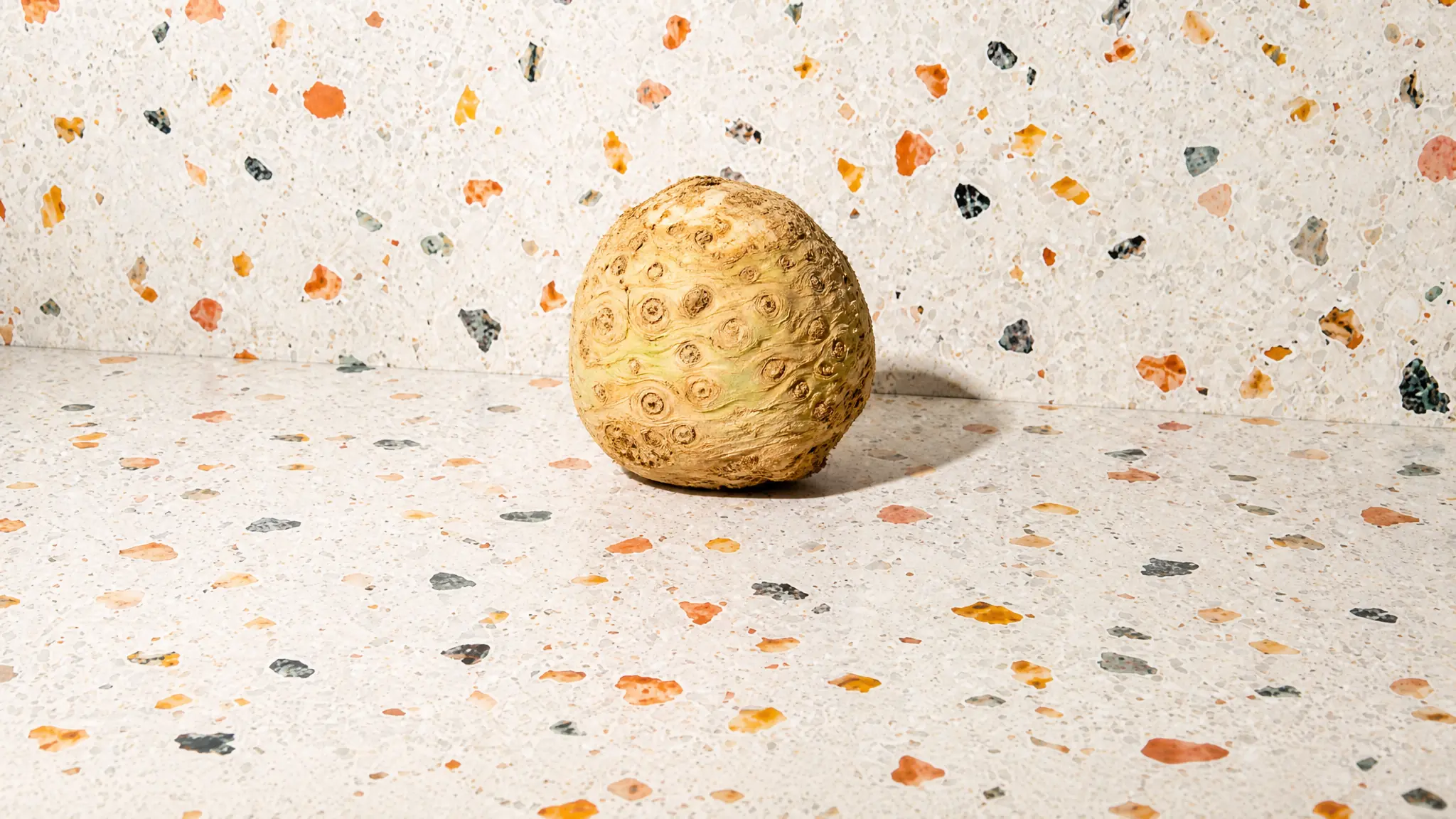
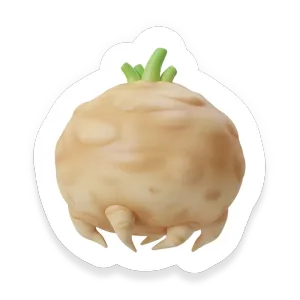
Celeriac (Celery Root)
Vegetable
Last updated July 5, 2026. The Tummi Food Team maintains this Can I Feed This safety guide guide. Supporting links appear in Sources when available.



Clinically reviewed by Andria Procopio and Arefa Mohamed
Direct answer
Can babies eat Celeriac (Celery Root)?
Yes, celeriac can be introduced around 6 months of age; peel, cook, and serve it in soft, manageable pieces to ensure safety and ease of eating.
- Serve Age6+months
Most babies start solids around 6 months once they show readiness signs. Match the texture and serving size to your baby's skills.
- No Allergens
Celeriac (Celery Root) is not flagged as one of the major allergens tracked in this database. Still watch your baby closely when serving any new food.
- Choking Risk123452
Lower choking risk when served in the right texture. Always supervise meals and adjust the shape for your baby.
This guide is for everyday food prep questions. Ask your pediatrician about medical concerns, feeding delays, allergy plans, or serious reactions.
How Do You Serve Celeriac (Celery Root)?
How to serve Celeriac (Celery Root) to babies 6 months and older
- 1Peel and cook whole celeriac until mashes easily between your thumb and forefinger; cut into large wedges or sticks about the width of two adult fingers so baby can hold and gnaw.
- 2For spoon-feeding, cook completely and mash or puree to a soft, scoopable consistency so baby can pick it up with a spoon.
- 3To add texture, finely grate peeled raw celeriac and mix a small amount into soft foods like yogurt or mashed vegetables; keep the shreds very fine.
- 4Always remove tough cores or stringy bits, check the temperature before serving, and supervise during eating.
How to serve Celeriac (Celery Root) to babies 9 months and older
- 1Peel celeriac thoroughly, then cook and cut into bite-sized pieces that are soft enough to easily squish between your thumb and index finger so the child can practice the pincer grasp.
- 2Offer larger cooked wedges or lightly mashed celeriac to encourage scooping with a spoon and to practice self-feeding motions.
- 3Introduce raw grated celeriac mixed into slaws or thin paper-like slices for biting and tearing practice; strong flavor can be mellowed by mixing with apple or yogurt.
- 4Always remove any tough core or fibrous bits, check temperature, and supervise while eating—discard any pieces that don’t mash easily between fingers.
How to serve Celeriac (Celery Root) to babies 12 months and older
- 1Peel the celeriac and choose a serving style: mash, roast into wedges, or slice/grate thinly for raw serving.
- 2If mashing or roasting, cook until very tender and cut into soft, easy-to-chew pieces so the child can gum or bite safely.
- 3For raw serving, grate or slice paper-thin, or cut into thin strips about the width of an adult finger. Only offer raw if the child has strong chewing and swallowing skills.
- 4Supervise at mealtime, provide an appropriate utensil for practice, and remove any tough or stringy parts that could be hard to chew.
Is Celeriac (Celery Root) a Common Allergen?
Celeriac (celery root) contains the same allergens as celery and should be treated as a potential allergen. Children with a known celery allergy or with birch‑pollen–related oral allergy syndrome may react to celeriac, ranging from mouth/throat itching to more severe reactions. Cooking may reduce some oral‑allergy reactions, but avoid offering celeriac to a child with known celery or pollen‑food allergies until cleared by an allergist. Seek urgent care for signs of anaphylaxis (difficulty breathing, swelling, hives, fainting).
Is Celeriac (Celery Root) a Choking Hazard?
Low Choking Risk
Celeriac is very firm and can be slippery, which increases the risk of choking for babies new to solid foods. Stay within arm’s reach during meals, watch closely for signs of choking versus gagging (inability to breathe, weak or silent cough, blue lips), and be prepared to act with infant choking first-aid. If you have concerns about your child’s chewing or swallowing skills, consult your pediatrician or a feeding specialist.
Have More Questions?
Yes. Celeriac can be stored in the refrigerator, wrapped or in an airtight container, for up to a few weeks to maintain freshness and prevent spoilage.
Yes. You can freeze pureed celeriac in airtight containers for up to 2-3 months, making it convenient to prepare ahead and store for future meals.
It depends. Organic celeriac is grown without synthetic pesticides, so choosing organic may reduce your baby’s exposure to chemicals, but conventional celeriac is also safe; wash thoroughly regardless.
Yes. You can combine cooked celeriac with other vegetables or grains to create varied textures and flavors for your baby, supporting diverse taste development.
It depends. Portion sizes can vary, but for babies around 6-8 months, start with 1-2 tablespoons of cooked and mashed celeriac, gradually increasing as tolerated and appetite grows.
Save Celeriac (Celery Root) to your food log
Track foods, reactions, and prep notes in Tummi when you want to keep your baby's feeding history in one place.
Sources
- Celery and Celeriac: A Critical View on Present and Future Breeding (Frontiers in Plant Science) frontiersin.org
- Field-Scale Evaluation of Botanical Extracts Effect on the Yield, Chemical Composition and Antioxidant Activity of Celeriac (Molecules) mdpi.com
- Oral allergy syndrome (American Journal of Rhinology & Allergy) journals.sagepub.com
- Oral Allergy Syndrome (AAAAI) aaaai.org
- Oral Allergy Syndrome: An Update for Stomatologists (Journal of Allergy) doi.org
- Influence of food processing on the allergenicity of celery (Allergy) doi.org
- Food-dependent exercise-induced anaphylaxis in the celery-mugwort-birch-spice syndrome (Allergy) doi.org
- Celery-dependent exercise-induced anaphylaxis (The Journal of Emergency Medicine) doi.org
- Phytophotodermatitis: the other 'lime' disease (Journal of Emergency Medicine) doi.org
- Nitrate in Leafy Green Vegetables and Estimated Intake (African Journal of Traditional, Complementary, and Alternative Medicines) doi.org
- AAP clinical report on infant methemoglobinemia (American Family Physician) aafp.org
- EFSA Explains: Nitrites and Nitrates Added in Food (EFSA) efsa.europa.eu
- Food sources of nitrates and nitrites (The American Journal of Clinical Nutrition) doi.org
- Infant methemoglobinemia: the role of dietary nitrate in food and water (Pediatrics) doi.org
- Vegetable-borne nitrate and nitrite and the risk of methaemoglobinaemia (Toxicology Letters) doi.org
What Other Vegetable Can Babies Eat?
See all →
Source-Linked Guidance
See the evidence behind the guide.
Food guides show direct links to public-health guidance and research when supporting references are available. Source inclusion does not imply endorsement.
 Centers for Disease Control and Prevention
Developmental milestones, nutrition guidelines, and allergen introduction timelines.
 American Academy of Pediatrics
Evidence-based feeding recommendations from the leading pediatric authority.
 National Institutes of Health
Peer-reviewed research on infant nutrition, allergies, and food safety.