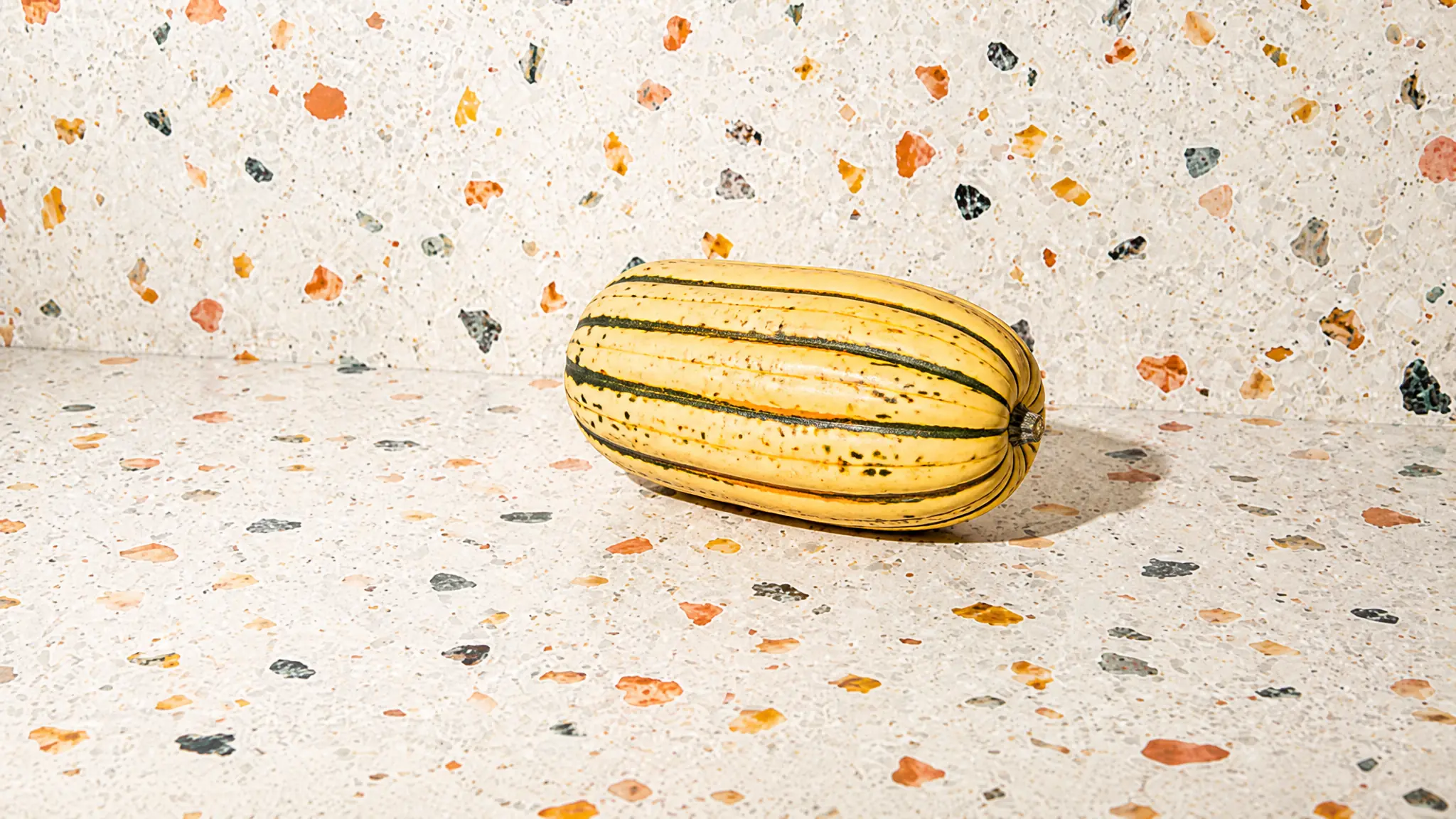
Delicata Squash
Vegetable
Last updated July 5, 2026. The Tummi Food Team maintains this Can I Feed This safety guide guide. Supporting links appear in Sources when available.



Clinically reviewed by Andria Procopio and Arefa Mohamed
Direct answer
Can babies eat Delicata Squash?
Yes, delicata squash can be introduced around 6 months once cooked until soft and mashed.
- Serve Age6+months
Most babies start solids around 6 months once they show readiness signs. Match the texture and serving size to your baby's skills.
- No Allergens
Delicata Squash is not flagged as one of the major allergens tracked in this database. Still watch your baby closely when serving any new food.
- Choking Risk123451
Lower choking risk when served in the right texture. Always supervise meals and adjust the shape for your baby.
This guide is for everyday food prep questions. Ask your pediatrician about medical concerns, feeding delays, allergy plans, or serious reactions.
How Do You Serve Delicata Squash?
How to serve Delicata Squash to babies 6 months and older
- 1Slice the squash into rings or half-moons and remove the seeds; leave the thin skin on for texture or peel if you prefer.
- 2Roast, steam, or simmer until the flesh is very soft and easily mashed with light pressure—typically 20–30 minutes depending on piece size.
- 3For older babies, mash lightly so they can scoop with fingers; for younger infants, puree or mash fully. Ensure pieces are soft with no hard edges before offering.
How to serve Delicata Squash to babies 9 months and older
- 1Cook (roast or steam) delicata until tender, then cut into thick rings (~1/2 inch) that are easy to grab. Remove seeds and leave the skin on so pieces hold together.
- 2Offer rings for self-feeding to encourage hand-to-mouth skills; always supervise during meals.
- 3When the pincer grasp emerges, cut into small, soft, bite-sized pieces; remove the peel if your child prefers a smoother texture.
- 4If you're unsure, mash the squash and offer it with a spoon to practice scooping and utensil use.
How to serve Delicata Squash to babies 12 months and older
- 1Cut into soft, bite-sized pieces or thin rings and cook (steam or roast) until tender so pieces can be easily mashed with gums.
- 2If the skin becomes soft when cooked, leave it on for extra nutrients; peel only if your child struggles to chew.
- 3Serve mashed or fork-mashed squash in a small dish, or offer strips/sticks that are easy to grasp and pose less choking risk.
- 4Place an age-appropriate utensil pre-loaded or within reach and supervise closely throughout the meal.
Is Delicata Squash a Common Allergen?
Delicata squash is not one of the major common food allergens (milk, eggs, fish, shellfish, tree nuts, peanuts, wheat, soy, sesame) and is generally well tolerated. Rare individual allergic reactions can occur, and cross-contact during processing or cooking (shared equipment or added ingredients such as nut oils) could introduce allergens. For infants or children with severe known allergies, introduce in small amounts and consult your pediatrician or allergist if you have concerns.
Is Delicata Squash a Choking Hazard?
Very Low Choking Risk
Undercooked or raw delicata squash can pose a choking risk, so ensure it’s very soft and easily mashes with light pressure before offering it to baby. The skin can be firm and sometimes hard to chew, so consider removing it if you’re concerned. Always supervise baby at mealtimes and stay within arm’s reach while they eat.
Have More Questions?
Yes, parents can store cooked delicata squash in an airtight container in the refrigerator for 3-4 days.
Yes, freezing pureed delicata squash in small portions allows for longer storage, typically up to 3 months in a freezer-safe container.
It depends; choosing organic delicata squash may reduce pesticide exposure, but conventional options are also nutritious when properly washed.
Yes, delicata squash can be combined with other fruits or vegetables suited for your baby's age to introduce new flavors and textures.
Portion sizes for babies vary; starting with 1-2 tablespoons of cooked, mashed delicata squash per meal is common, adjusting based on your baby's appetite.
Save Delicata Squash to your food log
Track foods, reactions, and prep notes in Tummi when you want to keep your baby's feeding history in one place.
Sources
- Regulatory control of carotenoid accumulation in winter squash during storage (Zhang et al., 2014) doi.org
- The Benefits and Risks of Certain Dietary Carotenoids... (Black et al., 2020) doi.org
- Allergy to pumpkin and cross-reactivity to other Cucurbitaceae fruits (Figueredo et al., 2000) doi.org
- Allergy caused by ingestion of zucchini (Reindl et al., 2000) doi.org
- Oral Allergy Syndrome: An Update for Stomatologists (Kashyap & Kashyap, 2015) doi.org
- Closing America's Fiber Intake Gap: Communication Strategies (Quagliani & Felt-Gunderson, 2016) doi.org
- Oral Allergy Syndrome (AAAI) aaaai.org
What Other Vegetable Can Babies Eat?
See all →


Source-Linked Guidance
See the evidence behind the guide.
Food guides show direct links to public-health guidance and research when supporting references are available. Source inclusion does not imply endorsement.
 Centers for Disease Control and Prevention
Developmental milestones, nutrition guidelines, and allergen introduction timelines.
 American Academy of Pediatrics
Evidence-based feeding recommendations from the leading pediatric authority.
 National Institutes of Health
Peer-reviewed research on infant nutrition, allergies, and food safety.