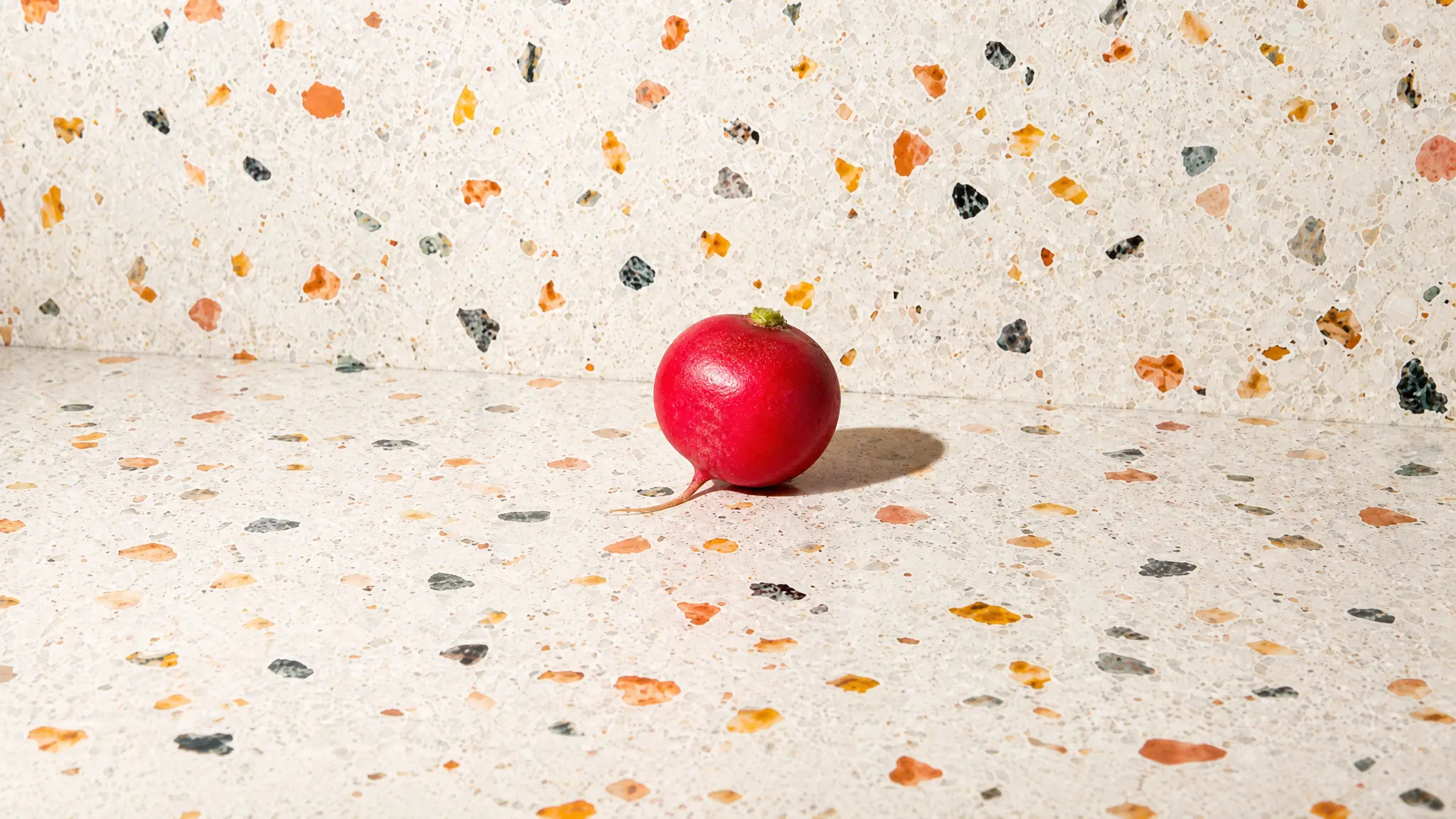
Radish
Vegetable
Last updated July 5, 2026. The Tummi Food Team maintains this Can I Feed This safety guide guide. Supporting links appear in Sources when available.



Clinically reviewed by Andria Procopio and Arefa Mohamed
Direct answer
Can babies eat Radish?
Yes, babies can eat radishes starting around 6 months, when they are ready to begin solids, with proper preparation and moderation.
- Serve Age6+months
Most babies start solids around 6 months once they show readiness signs. Match the texture and serving size to your baby's skills.
- No Allergens
Radish is not flagged as one of the major allergens tracked in this database. Still watch your baby closely when serving any new food.
- Choking Risk123453
Some choking risk. Use the prep section to change the size, shape, or texture before serving.
This guide is for everyday food prep questions. Ask your pediatrician about medical concerns, feeding delays, allergy plans, or serious reactions.
How Do You Serve Radish?
How to serve Radish to babies 6 months and older
- 1Cook radishes until very tender so a fork mashes them easily; drain and let cool slightly.
- 2Mash or puree to a smooth, lump-free texture so baby can scoop with hands or a pre-loaded spoon; serve in a small bowl.
- 3Offer a tiny pinch (crumb-sized) of very finely grated raw radish or a teaspoon of well-rinsed, minced pickled radish as a topping. Start small and watch for chewing difficulty or any signs of a reaction.
- 4Finely chop cooked radish greens and stir into the mash or another soft food for extra nutrients; ensure greens are very soft and free of stringy bits.
How to serve Radish to babies 9 months and older
- 1Wash and peel radish if the skin is tough, then steam or boil until very soft (about 8–10 minutes), and cut into quarters or thin slices so pieces are easy to pick up.
- 2For raw radish, grate finely and mix into a soft carrier (yogurt or mashed potato) to soften the flavor and texture.
- 3Offer cooked pieces that are soft and mashed at the edges to help chewing. Supervise every bite and remove any hard or stringy bits.
- 4Cook radish greens until tender, chop finely, and mix in small amounts; start with tiny portions to check tolerance and watch for choking.
How to serve Radish to babies 12 months and older
- 1Prepare raw radish by thinly slicing or grating so pieces are easy to chew; for a cooked option, steam or boil until very soft and cut into small, bite-sized pieces.
- 2Cut or grate pieces to small sizes (about pea-sized or up to 1/2 inch) based on your child's chewing ability to reduce choking risk.
- 3Offer with a child-sized fork or spoon to practice utensils, but allow finger-feeding when needed. Encourage independent self-feeding.
- 4Always supervise meals. Avoid hard, round, or large pieces; peel skins or cook longer if skins are tough to make them softer.
Is Radish a Common Allergen?
Radishes are not a common major allergen, but people with pollen allergies (especially birch or mugwort) can develop oral allergy syndrome (OAS) from raw radish, causing itching, tingling, or mild swelling of the lips, mouth, or throat. Cooking usually reduces the risk. Introduce radish as you would other vegetables, watch for mouth or throat symptoms, and seek urgent care for breathing difficulty or generalized hives.
Is Radish a Choking Hazard?
Moderate Choking Risk
Radishes can be a choking hazard because raw roots are hard and may be difficult for young babies to chew. Stay within arm’s reach and supervise closely during meals so you can intervene quickly if your baby gags or chokes. Introduce radishes cautiously and monitor how your baby handles different textures; contact your pediatrician if you have concerns.
Have More Questions?
Yes. Radishes can be introduced to babies around 6 months old, once they are ready to start solids.
Yes. Radishes provide fiber, vitamins, and antioxidants that support overall health and development in babies.
No, radishes are not a common allergen, but some sensitivities may exist especially in those allergic to other cruciferous vegetables.
Yes, raw radish's firmness and crunchiness can pose a choking risk; serve them in prepared, age-appropriate forms.
No. Raw radishes have a peppery taste, but cooking them makes the flavor milder; start with small amounts and watch for baby's reactions.
Save Radish to your food log
Track foods, reactions, and prep notes in Tummi when you want to keep your baby's feeding history in one place.
Sources
- Deciphering the Nutraceutical Potential of Raphanus sativus–A Comprehensive Overview (Manivannan et al., 2019) doi.org
- Fermented Foods: Definitions and Characteristics, Impact on the Gut Microbiota and Effects on Gastrointestinal Health and Disease (Dimidi et al., 2019) doi.org
- The First Microbial Colonizers of the Human Gut: Composition, Activities, and Health Implications of the Infant Gut Microbiota (Milani et al., 2017) doi.org
- Gut Microbiota–brain Axis (Wang & Wang, 2016) doi.org
- From Probiotics to Psychobiotics: Live Beneficial Bacteria Which Act on the Brain–Gut Axis (Bermúdez-Humarán et al., 2019) doi.org
- Structural diversity, functional aspects and future therapeutic applications of human gut microbiome (Ghosh & Pramanik, 2021) doi.org
- Changes in Quality and Antioxidant Enzyme Activities of Bunched and Topped Radish Plants during Storage (Tsouvaltzis & Brecht, 2014) doi.org
- A case of hand urticaria, lip angioedema, and oropharyngeal pruritus induced by Japanese radish (Abe et al., 2021) doi.org
- A Case of Anaphylaxis Induced by Contact with Young Radish (Lee et al., 2015) doi.org
- Allergic contact dermatitis from the radish (Mitchell & Jordan, 1974) doi.org
- Brassica oleracea pollen, a new source of occupational allergens (Hermanides et al., 2006) doi.org
- Oral Allergy Syndrome Caused by Japanese Radish: A Case Report (preprint) (Uesugi et al., 2021) doi.org
- Oral Allergy Syndrome: An Update for Stomatologists (Kashyap & Kashyap, 2015) doi.org
- Characterization of dietary fiber lignins from fruits and vegetables (Bunzel et al., 2005) doi.org
- Root Glucosinolate Profiles for Screening of Radish Genetic Resources (Yi et al., 2016) doi.org
- The Metabolism of Glucosinolates by Gut Microbiota (Sikorska-Zimny & Beneduce, 2021) doi.org
- Phenolic Compounds Promote Diversity of Gut Microbiota and Maintain Colonic Health (Domínguez-Avila et al., 2021) doi.org
- Systematic Investigation of the Effects of Seven Plant Extracts on Radish (Godlewska et al., 2021) doi.org
What Other Vegetable Can Babies Eat?
See all →
Source-Linked Guidance
See the evidence behind the guide.
Food guides show direct links to public-health guidance and research when supporting references are available. Source inclusion does not imply endorsement.
 Centers for Disease Control and Prevention
Developmental milestones, nutrition guidelines, and allergen introduction timelines.
 American Academy of Pediatrics
Evidence-based feeding recommendations from the leading pediatric authority.
 National Institutes of Health
Peer-reviewed research on infant nutrition, allergies, and food safety.